
Volume Builder vs Custom Home Builder: Which Is Right for Your Project?
My thoughts and experiences in dealing with both types of builders over the years
Short answer
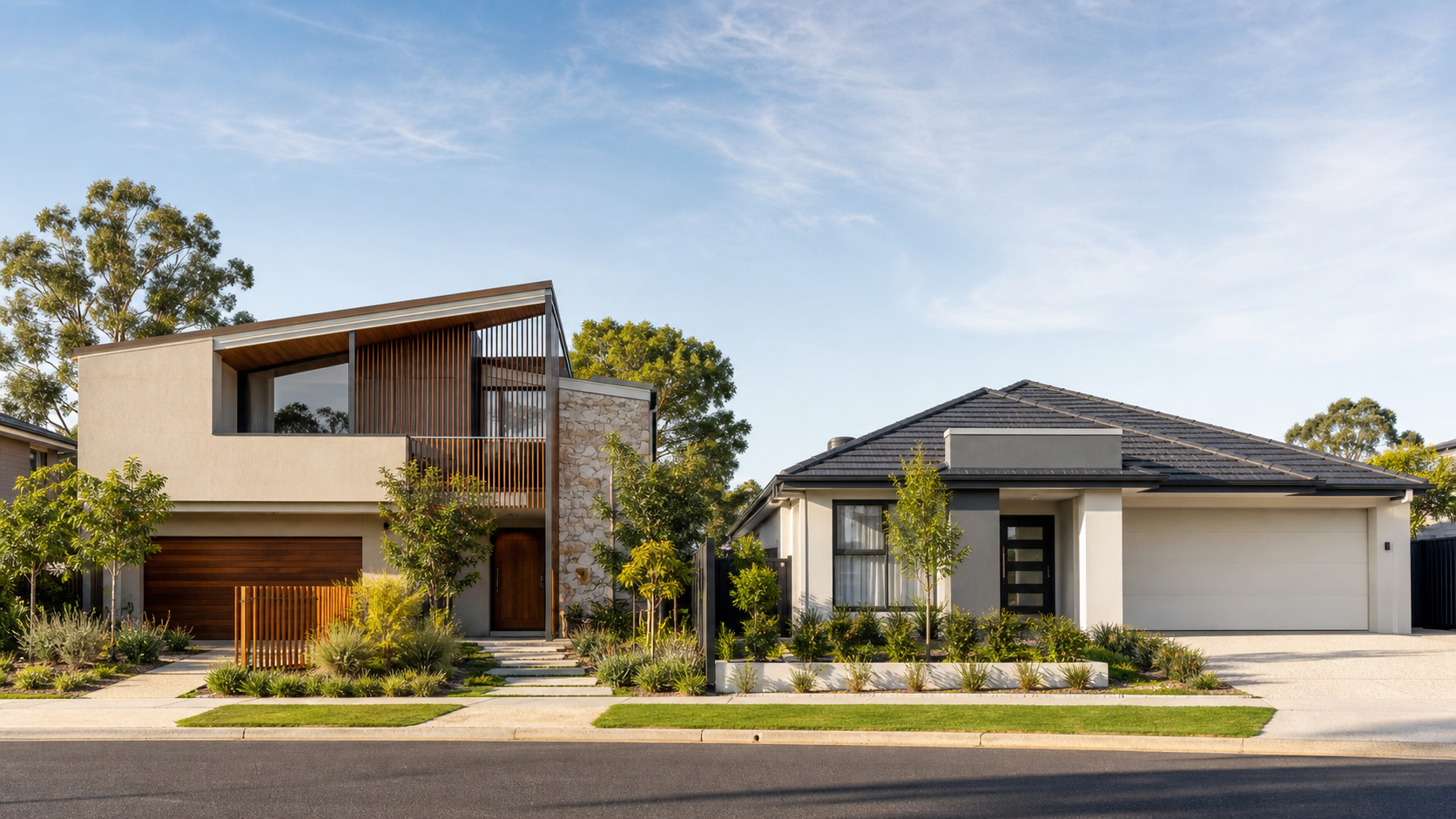
There is no universal right answer. A volume builder can be the right choice if you like one of their standard designs, your site is reasonably straightforward, you do not need major changes, and you are comfortable working within a structured process.
A custom home builder can be the right choice if your site, design, specification or level of flexibility requires a more tailored approach.
The mistake is assuming one is automatically better, cheaper or safer than the other.
The better question is:
Which building pathway suits your site, your budget, your design expectations and the way you want the project managed?
What is a volume builder?
A volume builder is a builder whose business model relies on building a high number of homes using repeatable designs, standardised systems, established supplier arrangements and defined product ranges.Most volume builders offer:
- standard home designs
- facade options
- display homes
- inclusions packages
- upgrade options
- colour and selection appointments
- defined internal processes
- separate departments for sales, estimating, drafting, contracts, selections and construction
That structure can be a real strength.
Because the builder is repeating similar designs and using known suppliers and trades, they can often create a more predictable and efficient process than a smaller builder working from scratch every time.
Another advantage of standard designs is time. Because the design, documentation, engineering assumptions, product ranges and estimating systems are already partly established, a volume builder may be able to move a client toward contract signing and site start faster than a fully custom pathway. That is not guaranteed, and it still depends on land, permits, site costs and the builder’s workload, but standardisation can reduce the time required to get the project ready to commence.
But the same structure can also become a limitation.
A volume builder is usually at its best when you are buying within their system, not trying to force their system to deliver a heavily customised project.
What is a custom home builder?
A custom home builder generally builds homes that are more specific to the client, the site and the design brief.This might include:
- a one-off new home
- a knockdown-rebuild on an established suburban block
- a major renovation or extension
- a sloping or difficult site
- an architect-designed home
- a higher-specification home
- a project where the client wants more control over design and finishes
Custom builders vary enormously.
Some are small owner-operated businesses with a builder, a few trusted subcontractors and some administration support. Others are larger businesses with project managers, estimators, contract administrators and site supervisors.
A custom builder is not automatically better than a volume builder. They are simply operating under a different model.
They usually provide more flexibility, but that flexibility needs to be supported by good documentation, realistic budgeting and clear communication.
Is a volume builder cheaper than a custom builder?
Sometimes. But not always.A volume builder may look cheaper at the start because the advertised base price is attached to a standard design and a standard inclusions package.
That base price can be useful, but it is not always the final project cost.
The final cost may be affected by:
- facade upgrades
- internal finish upgrades
- kitchen and bathroom upgrades
- electrical changes
- heating and cooling
- flooring
- window furnishings
- site costs
- soil conditions
- engineering requirements
- retaining walls
- drainage
- service connections
- demolition
- crossover works
- estate guidelines
- energy requirements
- bushfire requirements
- landscaping, fencing and driveways
A custom builder may appear more expensive at first because the price is often based on a more specific design and specification.
But if you compare a volume builder’s base price with a custom builder’s fully specified price, that is not a fair comparison.
The fair comparison is harder than it sounds.
In theory, you would compare a fully specified volume builder proposal against a fully specified custom builder proposal.
In practice, that is not always easy to do. A volume builder can usually price one of their standard designs because their product, inclusions and systems are already established. A custom builder is less likely to price that same home in exactly the same way, and taking a volume builder’s plans to a custom builder is not usually how the process is run.
A more practical approach, if you have the right support, is to create a basic preliminary design and apply a clear generic specification to it. That gives builders a more consistent scope to price and helps the client make a more meaningful comparison.
Even then, price is only part of the decision. Once the numbers are broadly understood, the bigger question may become:
Do I want to work within a volume builder’s system, or do I want more control, more flexibility and more direct engagement through a custom builder pathway?
That is often the real decision.
Another difference is pricing predictability. Volume builder pricing is usually more predictable for the base build because the design, standard inclusions and supplier arrangements are already established. The price can still move through upgrades, site costs, changes and exclusions, but the starting point is usually more structured.
Custom builder pricing can vary more significantly. A custom builder is pricing a one-off project, and their price may be affected by current workload, available staff, subcontractor availability and perceived risk. If the site looks difficult, the documentation is unclear, the client appears likely to need a lot of management, or the builder is already busy and would need to resource up to take the job, the builder may increase their margin or risk allowance.
When does a volume builder make sense?
- A volume builder may suit you if:you like one of their standard designs
- you want minimal design changes
- your site is relatively straightforward
- you want a potentially faster path from design selection to contract and site start
- you are happy with their standard inclusions or defined upgrade options
- you prefer a structured process
- you are comfortable dealing with different departments at different stages
- the builder already works in your area
- you want to see display homes before committing
- you want a known product rather than a one-off design
The strongest reason to use a volume builder is that their systems are designed for repeatable delivery.
If you like the design, understand the inclusions, accept the process and have a suitable site, a volume builder can be a sensible choice.
When can a volume builder become the wrong fit?
A volume builder can become the wrong fit when the project needs more flexibility than their system is designed to provide.That may happen if:
- you want major changes to the floor plan
- the site is difficult or unusual
- you want a highly specific design response
- you want finishes or materials outside their normal range
- you expect high levels of personal attention throughout the process
- you want flexibility during construction
- you are not comfortable being passed between departments
The more you customise a volume builder’s product, the more you move away from the thing that made it efficient in the first place.
Design changes can affect estimating, ordering, engineering, supervision and construction sequencing. A change that seems simple to a client may be disruptive inside a high-volume system.
That does not mean volume builders cannot handle changes. Many can. But the client needs to understand that changes may increase cost, reduce efficiency and increase the chance of miscommunication if they are not clearly documented.
Why the site supervisor matters
In both volume and custom building, the site supervisor or site manager matters.In volume building, this can be especially important because the supervisor may be managing several homes at the same time. The number varies between builders and market conditions, but the principle is the same: the supervisor’s workload and quality can have a major impact on the client experience.
By the time the project reaches site, the client may already have dealt with sales, drafting, estimating, colour selections, electrical selections and contract administration.
If decisions made earlier have not been properly documented and handed over, the issue may only appear once the project is under construction.
That is when small misunderstandings can become variations, delays or disputes.
Before signing, it is reasonable to ask:
- who will supervise the build?
- how many projects do supervisors usually manage?
- what happens if the supervisor changes?
- how are earlier selections and sales-stage promises transferred to the construction team?
- which documents actually form part of the contract?
When does a custom builder make sense?
- A custom builder may suit you if:you want a site-specific design
- you have a sloping, narrow, difficult or constrained site
- you are doing a major renovation or extension
- you want more control over finishes and specification
- you want to tender your own documented design
- you want more direct access to the builder or senior people
- your project needs flexibility during design and documentation
- the home is unusual, high-end, architect-designed or technically complex
Custom builders are generally better suited to projects where the home needs to be designed around the client and the site, rather than fitted into a pre-existing product range.
The benefits can be significant.
You may get more personal attention, more flexibility and a better project-specific response.
But custom building is not a shortcut around documentation, cost planning or process.
In fact, the more customised the project is, the more important those things become.
What are the risks of using a custom builder?
Custom builders vary widely in size, systems and capability.Some are highly organised businesses with strong administration, estimating and project-management systems. Others are excellent tradespeople and builders but may have more basic office systems.
Common risks to consider include:
- the business may depend heavily on one or two key people
- capacity can be hard to assess from the outside
- pricing may be less reliable if documents are incomplete
- smaller builders may have less administrative support
- communication may rely heavily on the builder personally
- if the relationship becomes strained, there may be fewer internal buffers
- cash flow pressure can affect behaviour in any building business
None of these points mean a custom builder is a bad choice.
Many custom builders are excellent operators and take enormous pride in their work.
The point is that you need to assess the builder, not just the category.
The “custom is always more expensive” myth.
There is a common assumption that custom builders are always more expensive.
That is not always true.
A volume builder’s base price may look cheaper, but once the client upgrades the specification, changes the layout, deals with site costs and brings the final product closer to what they actually want, the gap may reduce.
A well-documented custom project with a clear brief and competitive builder pricing can be more competitive than many people expect.
The cost is usually driven by the actual building: its size, structure, complexity, site conditions, level of finish and documentation quality.
A large house costs more than a small house.
A difficult site costs more than a simple site.
High-end finishes cost more than standard finishes.
Poor documentation creates more uncertainty.
Those principles apply whether the builder is volume or custom.
Are the materials and trades actually different?
Sometimes, but not always.Many core building materials are used across the market. Timber framing, structural steel, concrete, roof sheeting, PVC drainage, plasterboard and many internal products may be used on both standard family homes and high-end custom projects.
The same can be true of trades. A good trade contractor may work on a standard home one week and a more expensive custom home the next.
The difference is not always the raw material.
The difference is often:
- the design
- the detailing
- the specification
- the supervision
- the coordination
- the tolerances expected
- the time allowed to do the work properly
- the quality-control process
That is why “custom” does not automatically mean better and “volume” does not automatically mean poor quality.
The outcome depends on the project, the people, the documents and the management.
Why site conditions matter
Site conditions can change the decision.A volume builder may be a good fit on a straightforward site where the design sits comfortably, access is easy, the fall is manageable, services are clear and there are no unusual constraints.
A more difficult site may need a more tailored approach.
Important site factors include:
- slope
- rock
- soil classification
- access
- demolition
- drainage
- retaining walls
- trees
- easements
- council overlays
- bushfire requirements
- service locations
- neighbouring properties
- protection works risk
For knockdown-rebuild projects, the house price is only part of the decision.
The client also needs to understand demolition, service abolishment and reconnection, temporary fencing, asset protection, crossover requirements, stormwater, sewer location, soil conditions, trees, council requirements and costs outside the building contract.
A volume builder may provide a clear house package, but the client still needs to understand the whole project cost — not just the advertised home price.
Be careful when the builder controls the design
Some custom builders offer design-and-build services.This can be convenient. The design and construction team are aligned early, and the builder can provide practical input during design.
The trade-off is that the client may have less ability to test the price in the broader market unless the process is set up carefully.
If the builder controls the design and the client becomes emotionally and financially committed before the final construction price is known, the client may have limited negotiating power later.
That does not mean design-and-build is wrong.
It means the client should understand:
- who owns the design documents
- whether the documents can be priced by another builder
- when the construction price will be confirmed
- whether there is an independent cost plan
- what happens if the price comes in over budget
- whether there is a clear exit point
A quantity surveyor, independent cost planner or client-side adviser can help provide a benchmark during the design process, so the client is not relying only on the builder’s own estimate.
Financial capacity and builder stability
Financial stability matters for both volume builders and custom builders.There can be a perception that a large volume builder is automatically more financially stable than a smaller custom builder. That is not necessarily true. The collapse of Porter Davis is a clear reminder that size alone does not remove builder-failure risk.
The difficult part is that there is no perfect way for a client to know whether a builder is financially stable. Standard due diligence checks can help, but they are not foolproof. Credit reports, company searches, licence checks, insurance checks, trade references, supplier feedback and court or insolvency searches can all provide useful information, but their quality depends on the company structure, how current the data is, and what information is actually available at the time.
The same due diligence principles should apply to both volume builders and custom builders.
A separate builder due diligence guide can go much deeper into this, but the high-level checks usually include:
- licence and registration checks
- insurance certificates
- company and director searches
- credit reports where available
- recent financial information, if the builder is willing and the project justifies it
- current work-in-progress and future workload
- recent comparable projects
- references from previous clients, consultants, subcontractors or suppliers
- aged debtor and creditor risk, where that information is available
- ATO or tax-payment issues, where disclosed or discoverable
- litigation, claims or insolvency history
- evidence that the builder has the people, systems, subcontractor relationships and project-management capacity to deliver the work
Unfortunately, the fact is, both custom and volume home builders do go broke.
A better protection strategy is to combine due diligence with a properly structured contract and payment schedule. If something does go wrong with the builder, the client wants to be in a position where the amount paid broadly reflects the work actually delivered on site.
This is why progress payments schedule matters. Paying too far ahead of completed work increases the client’s exposure if the builder becomes insolvent, slows down, or the relationship breaks down. Most builders will always try and "front-load" their claim structures in order to improve their cash flow , so some oversight is most certainly warranted.
You may have more room to negotiate payment stages, special conditions or contract administration processes with a custom builder than with a large volume builder. Volume builders often operate under more fixed internal systems and may be less willing to change standard contract conditions.
That does not make one pathway automatically safer than the other. It means financial due diligence, contract setup and payment control are important whichever builder type you choose.
Independent building inspections
Whether you use a volume builder or a custom builder, you should consider having an independent building inspector involved during construction. Many inspectors carry out stage inspections, but waterproofing deserves particular attention. Waterproofing defects can be expensive, disruptive and difficult to fix once tiles, finishes and fixtures are installed.
Before signing, confirm that the builder agrees to independent inspections and will provide reasonable access for the inspector to carry them out.
It is also important to clarify what happens if the inspector identifies a defect or non-conformance. The builder should agree to address items that are properly supported by the National Construction Code, Australian Standards, manufacturer requirements, accepted tolerances or recognised good building practice.
The goal is not to create arguments or give the inspector unlimited authority over the builder. The goal is to avoid a situation where the builder says, “Yes, you can have an inspector, but we are not required to do anything even if the inspector says something is wrong.”
That position is not useful for the client.
The inspection process should be clear before the contract is signed.
Questions to ask a volume builder
- Before committing to a volume builder, ask: What is included in the base price?
- What is excluded?
- What are the common upgrade costs?
- How are site costs assessed?
- Are site costs fixed, provisional or subject to change?
- What happens if I change the design?
- Which selections are standard and which are upgrades?
- Who do I deal with at each stage?
- Who will supervise the build?
- How many projects does the supervisor usually manage?
- What happens if the supervisor changes?
- Will you allow an independent building inspector to inspect key stages, including waterproofing?
- Will you provide reasonable access for the inspector?
- Will you address defects or non-conformances identified by the inspector where they are supported by the NCC, Australian Standards, manufacturer requirements, accepted tolerances or recognised good building practice?
- What due diligence can I do on your financial capacity, licence, insurance and recent trading history?
- How are progress payments structured so payments broadly match work actually completed on site?
- Are any payment stages, special conditions or contract administration processes negotiable?
- Which documents form part of the contract?
- Are promotional inclusions clearly included in the contract documents?
- Are verbal discussions or emails included, or do they need to be written into the formal documents?
Questions to ask a custom builder
- Before committing to a custom builder, ask:Have you built similar projects before?
- Do you build regularly in this area?
- Who will manage the project day to day?
- How many projects do you currently have underway?
- What systems do you use for communication, variations and progress claims?
- Will you allow an independent building inspector to inspect key stages, including waterproofing?
- Will you provide reasonable access for the inspector?
- Will you address defects or non-conformances identified by the inspector where they are supported by the NCC, Australian Standards, manufacturer requirements, accepted tolerances or recognised good building practice?
- What due diligence can I do on your financial capacity, licence, insurance and recent trading history?
- How are progress payments structured so payments broadly match work actually completed on site?
- Are payment stages, special conditions or contract administration processes negotiable?
- Is your price a fixed price, estimate or budget?
- What documentation do you need before pricing properly?
- How do you price variations?
- What is your markup on prime cost items and provisional sum items?
- What is excluded from your price?
- Are provisional sums and allowances realistic?
- Are you comfortable working with an architect, designer, quantity surveyor or client-side adviser?
- Can your price be compared against other builders on the same scope?
Decision table: which builder type may suit your project?
You like a standard design and want minimal changes - Volume builder
You want a one-off design - Custom builder
Your site is flat and straightforward - Either, depending on design and inclusions
Your site has slope, access constraints or unusual conditions - Often custom builder
You want a structured process with defined options - Volume builder
You want high control over finishes and detailing -Custom builder
You are doing a major renovation or extension - Custom builder or renovation specialist
You want to tender one documented scope to several builders - Custom builder
You want the lowest advertised starting price - Volume builder, but check final inclusions carefully
You want direct access to the builder or senior people - Often custom builder
You are happy to work through departments and set processes - Volume builder
Final recommendation
Do not choose a builder type based only on the label.A good volume builder can be the right choice for the right project.
A good custom builder can be the right choice for a different project.
The most important thing is to understand what you are actually buying.
Before committing, make sure you understand:
- the final scope
- the inclusions
- the exclusions
- the site costs
- the allowances
- the upgrade costs
- the contract documents
- the builder’s process
- who will manage the project
- how changes will be handled
- whether the builder’s model suits your project
A volume builder is not automatically inferior.
A custom builder is not automatically better.
And the cheapest-looking price is not always the cheapest finished project.
If you are unsure, an independent review of your documents, inclusions, exclusions and builder proposal can help you understand the risks before you sign.
All the best with your decision making and construction journey.
Jeremy Bacon - Director - Founder - Build Success Partners
Recent Posts